How to Preserve Muscle While Taking Ozempic
How to preserve muscle while taking Ozempic with a 1.2–1.6 g/kg protein target, 2–3 lifts a week, and strength checks beyond the scale.

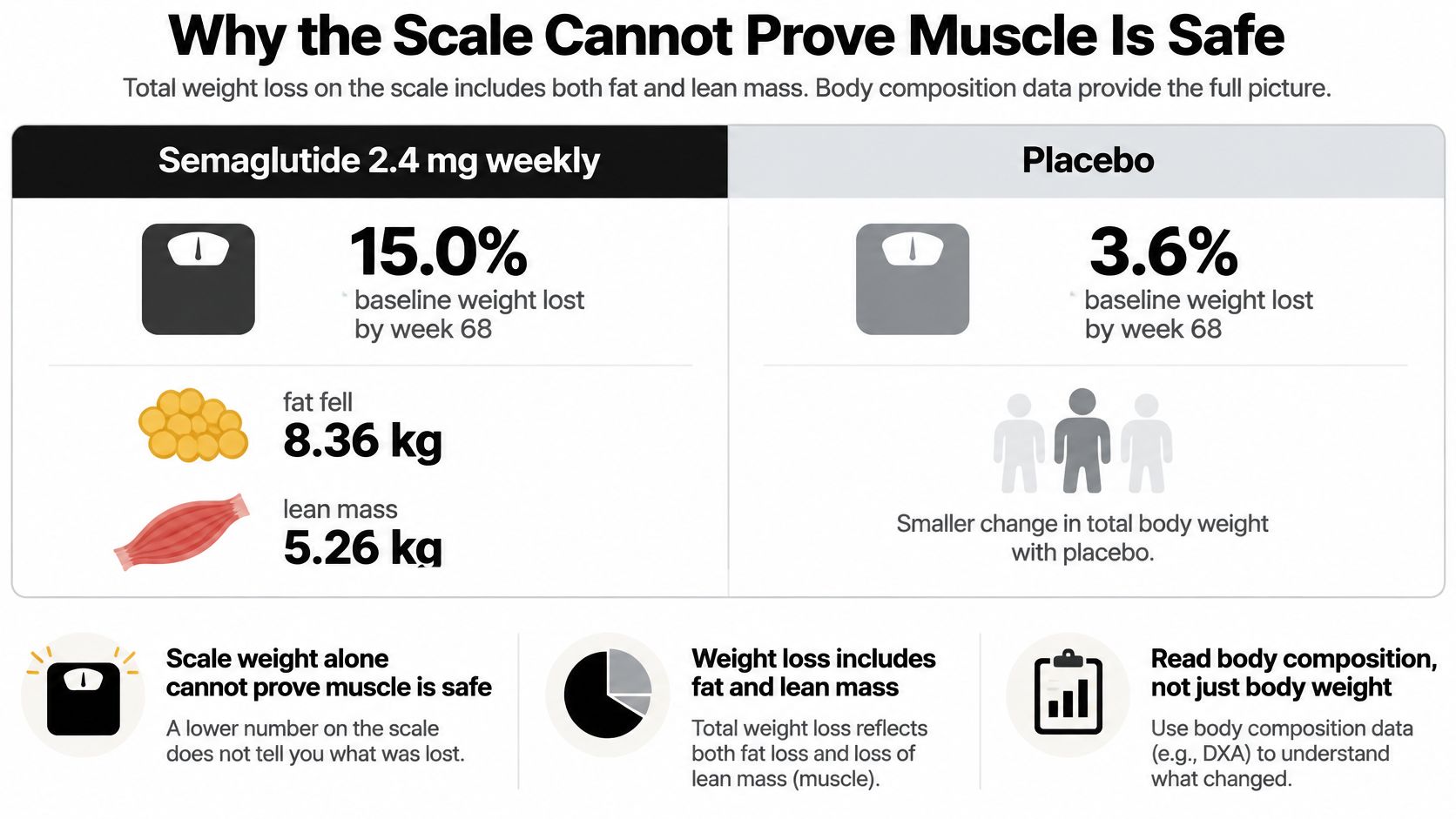
Adults receiving semaglutide 2.4 mg weekly lost 15.0% of baseline body weight by week 68 in the STEP 1 body-composition analysis, compared with 3.6% on placebo. In that same analysis, semaglutide cut total fat mass by 8.36 kg and total lean body mass by 5.26 kg, while placebo cut fat by 1.37 kg and lean mass by 1.83 kg.
That is the reframe for how to preserve muscle while taking Ozempic. The scale moved a lot, and a large slice of the change was lean tissue, not fat alone. A higher share of "lean" on a report can show up even while absolute lean tissue falls. I would treat repeatable strength, protein you swallow, and a waist measurement as the scorecard, and treat a smart-scale lean-mass percentage as a rumor until a clinician puts a better tool on it.
Why the Scale Cannot Prove Muscle Is Safe
STEP 1 ran for 68 weeks in adults with overweight or obesity. Its results speak most directly to medically supervised weight management, not to every person taking a diabetes dose. Fat and lean body mass both fell.
A companion analysis of the same body-composition data found that total lean mass fell 9.7% from baseline while lean mass as a share of body weight rose by 3.0 percentage points, as reported in the semaglutide body-composition study. A higher lean-mass percentage can accompany a loss of lean tissue. Scale weight and a smart-scale percentage cannot establish whether strength is holding.
The range is wide, so one reading is not a verdict
A 2024 systematic review of six semaglutide studies in 1,541 adults found that lean-mass reductions ranged from nearly 0% to 40% of total weight lost. That range means one person's experience cannot predict another's. A bathroom scale also cannot show how much of a weight change came from lean tissue.
Timing matters. In the SEMALEAN study of 115 adults with obesity, lean mass declined by 3 kg after 7 months of semaglutide, then stabilized at 12 months. Track function and repeatable strength as treatment progresses rather than relying on a single body-composition reading.
Practical rule: Record what you can repeat. Do not overhaul food or training because a consumer scale shows a lower muscle percentage.
What to record before the next dose step
Before starting or increasing a dose, record body weight, waist circumference, and the load and reps for two or three lifts you can repeat. If your clinician uses DXA or validated bioimpedance, follow their approach. Recheck body measures about every 8 to 12 weeks. Each week, note completed sessions, reps or loads, protein consumed, hydration, and nausea, vomiting, or early fullness.
Look for a persistent pattern, not one difficult afternoon.
| Signal | What to record | When to act |
|---|---|---|
| Strength | Reps and load on the same two or three exercises | A drop that lasts several sessions, not one tired day |
| Protein | Grams actually eaten on appetite-limited days | Several days well under the agreed target |
| Scale and waist | Weight plus waist, read together | Faster loss than the prescriber planned |
| Function | Sit-to-stand, gait, or grip if you already test it | A clear decline in the test or in daily tasks |
| Body composition | DXA or validated bioimpedance about every 8-12 weeks, if offered | Do not overhaul the plan from one smart-scale reading |
| Symptoms | Nausea, vomiting, early fullness, hydration | Intake collapsing or you cannot train safely |
Bring a persistent decline or intake problem to your prescriber. Do not change the dose yourself after a difficult week. Common problems include eating too little when appetite is low, putting nearly all protein in one meal, and replacing lifting with walking while the dose continues to climb.
Protein and Strength Targets to Start This Week
A practical starting target is 1.2–1.6 g of protein per kilogram of adjusted or target body weight per day, paired with full-body resistance training 2–3 times a week. A clinical review on early muscle-mass care recommends splitting protein across meals, aiming for about 20–30 g of high-quality protein at a time. It reports better fat-free-mass preservation around 1.1–1.6 g/kg/day than at 0.6–0.9 g/kg/day during weight loss, and emphasizes resistance training alongside protein.
During calorie restriction, lifting gives muscle a reason to adapt to the work you ask it to do. Protein supplies material for that adaptation. Moderate walking or cycling can fit on non-lifting days if it does not replace strength sessions.
When the fuller plan is too much
If appetite or recovery makes three lifting days unrealistic, keep a smaller, repeatable plan rather than stopping. An obesity-management guide for clinicians recommends resistance training 1–2 times a week and about 1.0–1.5 g of protein per kilogram of ideal body weight per day. American Association of Clinical Endocrinology guidance in that document gives a protein range of 1.2–1.5 g/kg/day, alongside regular resistance training. Protein by itself is not the fallback.
Ask a clinician to help choose adjusted, target, or ideal body weight if using current weight makes the daily gram target unrealistic. If you have kidney disease, get medical guidance before raising protein. Age, other medicines, and how much you can eat also affect the right target.
Two quick math checks
For a target weight of 70 kg, 1.2–1.6 g/kg works out to about 84–112 g of protein per day. At 90 kg, the same range is about 108–144 g. These are planning totals, not a reason to force food through nausea. For the 70 kg example, four meals of 25–30 g reach the lower end of the daily range. If early fullness makes meals difficult, use smaller portions across more eating windows.
| Lever | Target | Practical benchmark | Watch-out |
|---|---|---|---|
| Protein | 1.2–1.6 g per kg of adjusted or target body weight per day | About 20–30 g of high-quality protein per meal | Kidney disease needs medical clearance before you raise protein |
| Clinical floor | About 1.0–1.5 g per kg of ideal body weight, with resistance training 1–2 times weekly | Use when appetite or recovery cannot support the fuller plan | Keep lifting in the plan; protein alone is not a substitute |
| Fuller strength plan | Full-body resistance training 2–3 times weekly | Squat, hinge, push, pull, carry, and trunk work | Sessions can be 20–30 minutes; keep them focused rather than turning them into cardio circuits |
| Progression | Add load, reps, or difficulty when the set feels manageable | Log reps and load on the same exercises | The goal is repeatable strength, not sweat or calorie burn |
| Aerobic work | Add moderate walking or cycling on non-lifting days as tolerated | Keep it alongside the strength sessions | Do not let it displace lifting |
| Calorie pace | Eat enough to train and work toward the protein target | Avoid adding aggressive restriction on top of the medication | Call your prescriber about rapid, unintended weight loss |
Choose one row to put into practice this week, then confirm your protein target with a clinician or dietitian. Track reps and load on the same exercises; when the prescribed reps feel manageable, add load, reps, or difficulty. Weights, bands, machines, and body weight can all support squat, hinge, push, pull, carry, and trunk movements. Avoid adding another calorie cut just to speed up scale loss.
How to Hit Protein When Meals Stay Small
Reviews do not agree on one protein number, and that matters when nausea kills meal volume. A 2025 nutrition review lays out materially different frames: at least 0.8 g/kg/day, a higher weight-loss range, or about 1.5 g per kg of fat-free mass. Prolonged intake above 2 g/kg/day can create avoidable risks. More protein does not automatically offset muscle loss. The stronger case is still protein plus resistance training, especially for older adults, people with obesity, and anyone with kidney disease, who should set the number with a clinician.
The daily total has to be a number you can finish.
- Set today's grams from the adjusted or target-weight band you already agreed, then split them into three or four windows instead of one dinner.
- Open every window with a food that still works when you feel queasy: Greek yogurt, cottage cheese, eggs, tofu, fish, chicken, lean deli meat, or a ready shake if solids will not go down.
- Shrink the portion rather than skipping the protein. Half a chicken breast, a cup of yogurt, or one shake still counts toward the day.
- If fullness stops the first sitting, add a second small source later, such as cheese, edamame, or milk, so the day is not a single meal.
- Log what you swallowed, not what you plated. Leftovers on the plate are not intake.
- If vomiting continues, or you cannot approach the target for several days, stop forcing volume and contact the prescriber. Do not stack powders to close the gap.
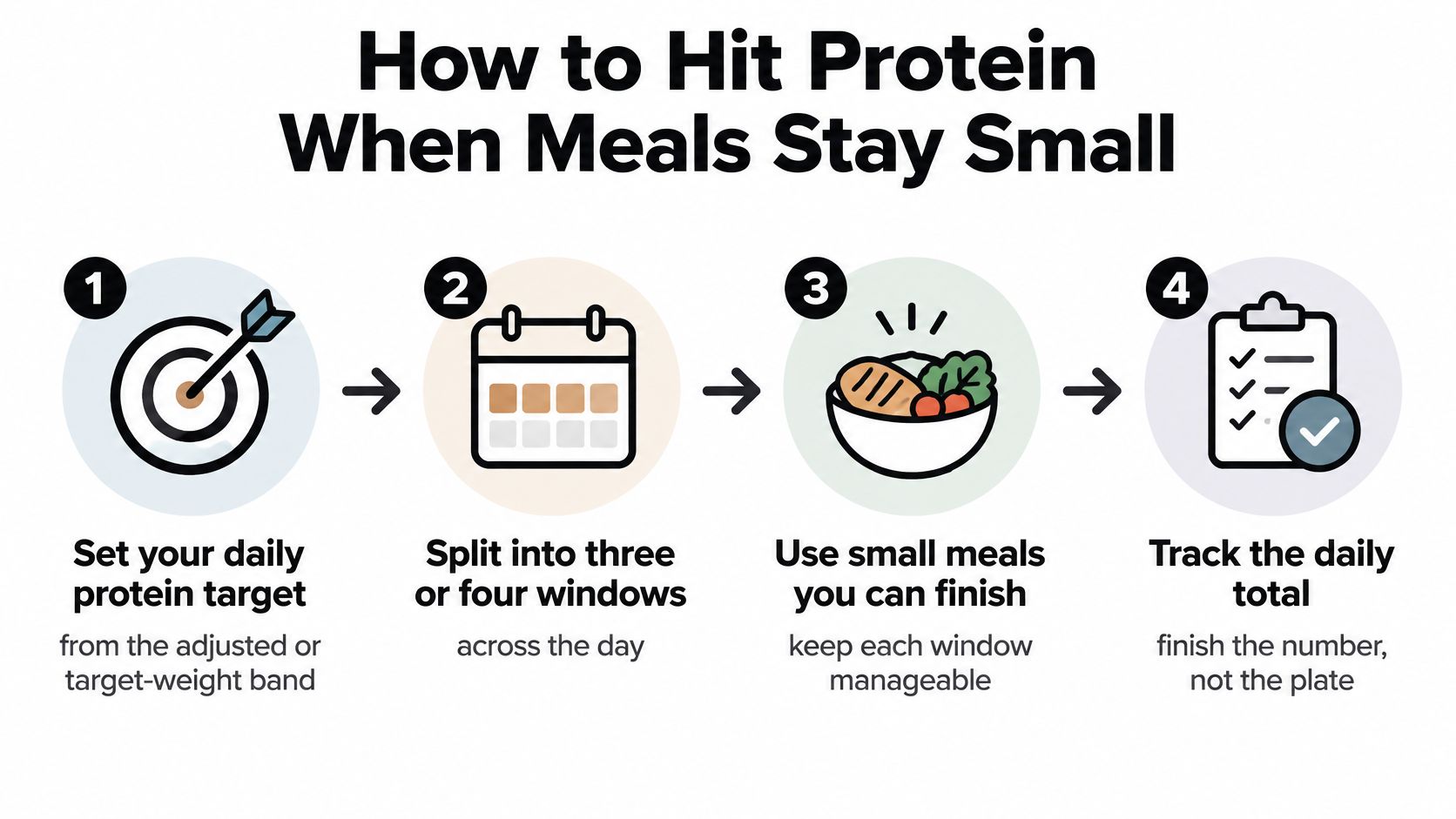
A day that still fits in a small stomach
A copyable day for a moderate target is a shake in the morning, yogurt midafternoon, and a palm of fish or tofu at the meal you tolerate best. That is three protein hits without a large plate. If the shake is the only thing that stays down, count it and keep the other windows small rather than empty.
Say you are in an airport with early fullness. Order yogurt and a turkey wrap, eat the protein half, and save the rest for the gate. The pastry is easier, and it does nothing for the gram total. The wrap you finish later still does.
Cold, soft, or liquid protein beats a perfect menu you cannot face. The gram you swallow is the only gram that counts.
Individualize if you are older, if obesity changes which body weight you should multiply, or if kidneys have not been cleared for a higher intake. The fat-free-mass frame is another way to think, not a reason to push past a high body-weight intake for weeks. When the day fails, tell the prescriber what you ate. That is more useful than a target you wrote down and never reached.
How to Lift When Time and Energy Are Short
Protect two or three days even when each session is only 20–30 minutes. The goal is a mechanical load on the big patterns, not a long gym tour and not a sweat score. Training does not cancel the drug. It gives muscle a reason to stay while weight comes off under medical care.
A short session only works if you can picture it. This is the shape of a home set: one squat pattern, then the rest of the list, done before the day gets away.
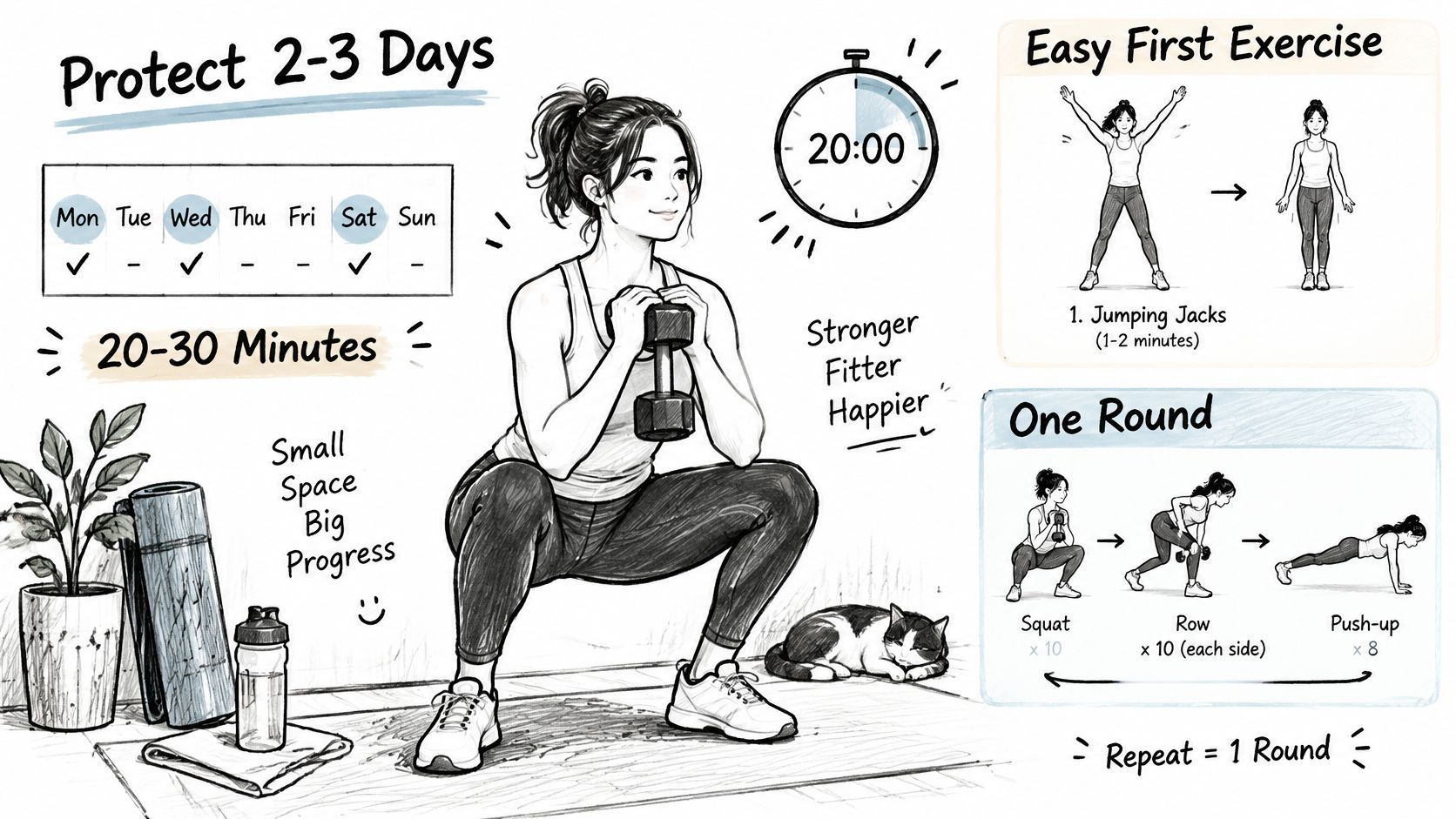
Six patterns, then you leave
- Put the days on the calendar first. A session you did not schedule will lose to email.
- Start the first exercise easy and call that the warm-up. You do not need a separate 15-minute cardio block.
- Complete one round of six patterns: a squat or sit-to-stand, a hinge such as a Romanian deadlift or hip hinge, a push such as a push-up or press, a pull such as a row or band pull, a carry if you have a weight, and a plank or dead bug.
- Do 2–3 sets of 6–12 controlled reps, leaving 1–2 reps in reserve so nausea is not what ends the set.
- Rest long enough that the next set stays strong. Short rests that turn the hour into a circuit are a different workout.
- Write the load and the reps before you leave.
- Next time, add a little load, one rep, or a harder variation only if the last session was clean.
A home setup with one kettlebell can be a goblet squat, a deadlift, a push-up, a backpack row, a suitcase carry, and a plank. That is the whole list. On the day after an injection, keep every pattern and drop to one set each rather than skipping the week. Walking can sit around the lifts. It does not replace them.
Stop and get care for chest pain, dizziness, or vomiting. Those are not "push through" signals.
For a clean walk-through of the patterns at a pace you can copy at home, this short demo is worth one viewing before you write your own template.
A two-week template you do not edit yet
Write the six patterns on three days and repeat that sheet for two weeks before you change exercises. Day A and Day B can use the same movements. The only change allowed is a small load or rep bump when the last session was clean. If a set felt sloppy, repeat the same load.
Leave one or two reps in the tank. A set that makes you nauseated is not a better stimulus.
Judge the block by sessions finished and by whether the same lift is steady or slightly stronger. A harder variation you cannot repeat next week is not progress. If you only have a hotel room, the same six patterns still fit: sit-to-stand, hip hinge, push-up, towel or suitcase row, a carry with a bag, and a dead bug on the floor.
Fixing Nausea Travel and Injection-Day Slumps
Use these fixes when the base plan is right and the day is not. Do not fast to "help the medication work." Low intake is how strength sessions and protein targets die in the same week.
Nausea. Try colder foods, smaller bites, and sip fluids apart from meals if drinking with food makes fullness worse. A shake you can finish beats a hot plate you abandon. If vomiting is ongoing, that is a prescriber call, not a willpower problem.
Travel. Pack yogurt, cheese sticks, or another protein you already tolerate so a delayed meal does not zero the day. Airport pastry is the default when you packed nothing. When there is no gym, run a short circuit of squats, push-ups, and a suitcase row, and keep the other patterns from your lifting sheet if the room allows. Short and complete beats a missed week.
Injection-day fatigue. Cut to one set per pattern and keep every pattern. Skipping the week trains the habit of skipping. The next session goes back to your normal sets if you feel steady, not to a makeup workout that is twice as long.
Fluids. Keep them steady through the day. Dark urine or dizziness means you pause hard work and contact care. Do not "test" a heavy set to see if it passes.
Creatine is a question for your clinician, not a stand-in for food and lifting. Fat-burner stacks do not belong in this plan. They do not fix a missed protein window, and they add side effects you do not need on top of a dose that already changes appetite.
Judge the week by sessions finished and by protein days you hit. One low weigh-in is not the verdict. If a flight or a shift schedule erases the plan for two weeks running, shorten the session and the meal target together, then tell your clinician the plan is not holding. A smaller plan you repeat beats a perfect plan you abandon until the next dose change.
Confirm the Next Two Weeks With Your Clinician
Before the next dose change, bring three numbers, not a vibe. Protein grams you are finishing. Strength sessions you completed. Whether a key lift or a sit-to-stand is steady, down, or up.
Ask which body weight the protein target should use, ideal, adjusted, or current, given your kidneys, age, and other medicines. Ask what weekly loss they want, and which symptoms should pause a dose increase. Those answers beat another week of guessing from the scale.
Then lock 14 days to the plan you already chose. The protein band you can finish in small meals. Two or three lift days using the same six patterns. A weekly log of load, protein, and nausea. Do not buy a new scale ritual this week, and do not cut calories harder to force a faster drop.
Success over the next month is strength that holds while weight trends down under medical supervision. It is not the lowest number on the scale, and it is not a higher lean-mass percentage from a consumer device. If vomiting, dizziness, or a sudden performance crash shows up, that call comes before any new workout. I would rather pause a progression for a week than explain a fall or a faint in the clinic later.
You already have the pass-or-call list. Use it. If a row fails, the prescriber hears it before you invent a fix.
Coach F.I.T. coaches fitness, food, and day-to-day adjustments by text, including shorter sessions and meal swaps when a GLP-1 makes appetite, travel, or energy unpredictable. If you want that kind of check-in while you protect strength during weight loss, start a conversation at Coach F.I.T..